You Don't Need More Staff to Scale Your Wedding Business. You Need a System.


## The Organizer Who Was Everywhere, and Nowhere
There is a version of success in the wedding industry that looks impressive from the outside and feels like slow drowning from the inside. You are booked months ahead. Clients are referring you to their friends. Your name carries weight in the right circles. And yet, every single event still requires you to be physically, mentally, and emotionally present at its center, because without you, things fall apart. That is not a thriving business. That is a founder-dependent operation wearing the costume of one.
If you have ever caught yourself thinking 'I cannot take on another event because I simply cannot be in two places at once,' this conversation is for you.
## The Invisible Work Nobody Talks About
Before we talk about scaling, we need to name what is actually happening beneath the surface of every premium wedding you coordinate. There is the visible work: the timeline, the vendor calls, the on-the-day execution. And then there is the invisible work, the part that consumes far more of your capacity than it should.
Who confirmed their attendance and who has gone silent? Which table arrangement reflects the updated RSVP count, and which one is based on a list from three weeks ago? Has the bride's mother been moved to a dietary requirement that the caterer does not yet know about? Is the digital invitation still sending to an email address the guest changed last month?
This invisible work lives in your head, in your WhatsApp scroll history, in a spreadsheet that three people have edited without telling each other. It is the connective tissue of the entire event, and right now, you are the only one holding it together. That is the actual problem. Not your team size. Not your pricing. The system, or the absence of one.
## The Conflict: When Growth Becomes the Enemy
Here is the painful irony of a founder-dependent wedding business. The better you are at your craft, the more demand you attract. And the more demand you attract, the more you are pulled in contradictory directions. A second event on the calendar does not just add workload. It multiplies complexity.
Guest list A bleeds into your mental bandwidth for guest list B. A last-minute RSVP change on one event forces you to manually cross-reference three documents to understand the impact. You are managing two brides, two sets of families, two venues, and two entirely separate universes of guest data, all of it stored in formats that only make sense to you.
The result is not just operational chaos. It is reputational risk. One missed dietary note, one outdated seating arrangement sent to a venue, one digital invitation that bounced because the contact detail was never updated. These are not small errors. In the premium wedding market, they are career-defining moments. And when you are the system, the failure is always personal.
What often happens at this point is that WOs hire more staff. Another coordinator, an assistant, a part-time admin. But here is what nobody says out loud: more people managing a broken process does not fix the process. It just distributes the chaos across more salaries.
## The Comeback: When the Data Becomes the Organizer
The shift from a founder-dependent business to a system-dependent one is not about removing yourself from the work. It is about removing yourself from being the only source of truth.
Imagine this instead. Every guest, across every event you are managing, exists inside a single centralized dashboard. RSVP status, dietary requirements, table assignments, contact details, invitation delivery confirmation. All of it live, all of it accurate, all of it accessible by anyone on your team with the appropriate permissions. When something changes, the system knows. When a guest has not responded, the system flags it. When the final count is needed for the venue, it takes thirty seconds, not thirty minutes.
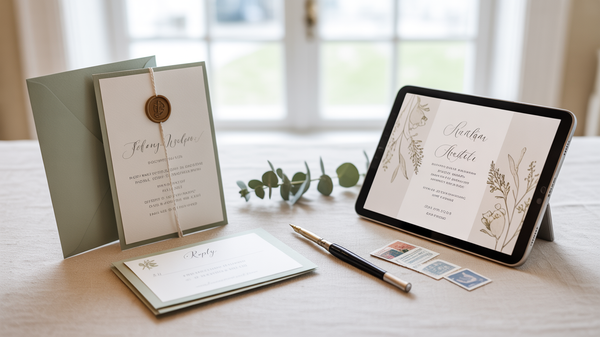
This is what a web-based digital invitation and guest management platform actually does when it is built for the operational reality of professional wedding coordination. It does not just send a pretty invitation. It becomes the connective tissue that was previously living only in your head.
And here is what that unlocks practically. You can have a team member handle guest communication for Event A while you are on-site at Event B, because they are not dependent on your knowledge. They are dependent on the same centralized data you are both looking at. The system is the organizer. You are the strategist.
Two events become manageable. Three become possible. Five become a business model.
## What Scaling Actually Looks Like in Practice
Let us be specific, because this is where the before-and-after becomes real.
Before: A guest RSVP changes. The guest messages the bride directly. The bride calls you. You update the spreadsheet, message the caterer, make a note to adjust the seating chart, and hope you remember to tell your assistant. Three days later, the venue receives an outdated PDF.
After: A guest RSVP changes through the digital invitation system. The dashboard updates in real time. Your team sees it. The count adjusts. You receive a notification. The correct number goes to the venue because you are working from a single live document, not a chain of forwarded messages.
That is not a minor efficiency improvement. That is the difference between a business that scales and a business that suffers at scale.
The paper-based coordinator is not less capable than the system-based one. She is simply spending her capability on the wrong things. On memory. On manual updates. On being the bridge between information that should already be connected.
## This Is a Systems Problem, and Systems Have Solutions
If you are at the point where growth feels threatening rather than exciting, that is a signal worth paying attention to. It is telling you that your current infrastructure was built for a smaller version of your business, and it is now holding you back.
The solution is not to slow down. It is not to hire a second version of yourself. It is to build the kind of operational foundation where the data does the organizing, the system does the remembering, and your expertise is reserved for the decisions that actually require a human being.
Wedwebs exists specifically for this transition. Not to replace the art of what you do, but to carry the operational weight that should never have been yours to carry manually in the first place.
If you are thinking about what that shift could look like for your specific business, I would genuinely enjoy that conversation. No pressure, no pitch. Just a practical discussion about where the gaps are and whether what we have built could close them.