The Third Identity: How Great Design Handles Cross-Cultural Wedding Invitations
Cross-cultural wedding invitations are among the most demanding briefs in wedding design. Here is the framework that turns two distinct heritages into one cohesive visual identity that belongs entirely to the couple.

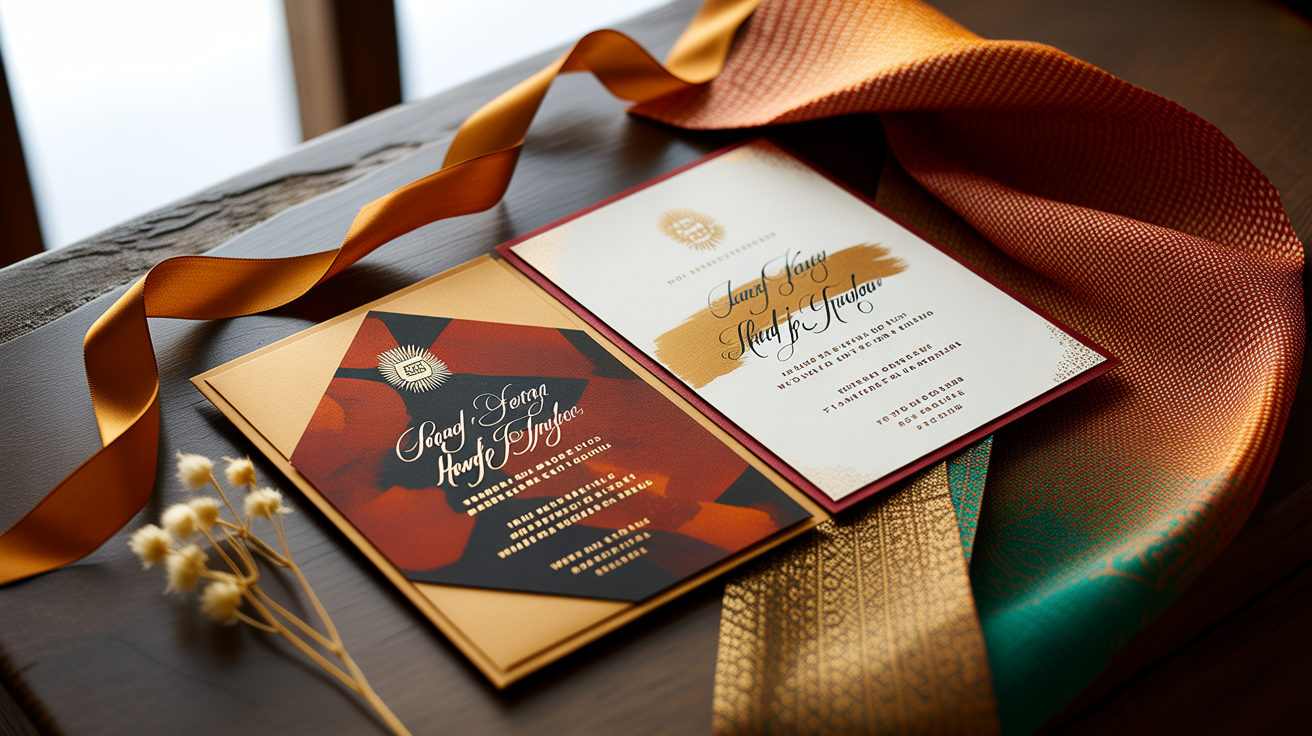
When Two Aesthetics Meet, Something New Has to Be Born
The cross-cultural wedding brief is, without question, one of the most demanding a designer can receive. Not because the source material is difficult to find -- Nigerian Aso-oke textile patterns and Chinese ink-wash calligraphy are both rich, storied traditions -- but because the brief is almost never stated correctly. Couples say they want 'both cultures represented.' What they actually need is something harder to articulate: a design that feels inevitable. Unified. Like it could only ever belong to them.
Generic template platforms cannot do this. They were built for replication, not synthesis. Choosing a 'Nigerian-inspired' template and layering a red envelope motif on top of it does not create a cross-cultural invitation. It creates a collision -- two aesthetics competing for the same visual real estate, neither one landing with the dignity it deserves.
The demand for this kind of work is growing. As more couples across Lagos, Sydney, Toronto, and Dubai build lives that genuinely straddle two heritages, the invitation becomes the first real test of whether anyone in their vendor team truly understands what they are navigating.
Why This Brief Is Technically Harder Than It Looks
Every cultural aesthetic carries embedded assumptions -- about scale, color temperature, negative space, and hierarchy. West African design traditions often operate at high visual intensity: bold color fields, large-scale pattern repetition, density as a form of celebration. Traditional Chinese wedding aesthetics, particularly in their more classical expressions, favor restraint, symbolic precision, and the weight of a single well-placed character over decorative abundance.
These are not opposing preferences. But they do operate on different visual frequencies. Placing them side by side without mediation produces noise. The designer's job is not to muffle either tradition -- it is to find the frequency both can share.
That search for shared frequency is the actual creative brief.
Finding the Shared Visual DNA
The framework that works across almost every cross-cultural pairing begins with three diagnostic questions before any design decision is made.
Color temperature. Does each culture's palette trend warm or cool? Nigerian ceremonial colors -- the deep terracotta of Aso-oke weaves, the rich emerald and gold of Yoruba aso-ebi -- run warm. Chinese bridal red, when examined against ivory and gold, also runs warm. That shared temperature is not a coincidence. It is the first line of structural agreement, and it tells the designer where the foundation can be built.
Motif scale and geometry. Identify whether each tradition's decorative vocabulary operates at macro or micro scale. Large woven textile blocks versus fine brushwork line work can coexist if they are assigned different spatial roles -- one governs the background field, the other governs fine detail. Conflict happens when both compete for the same layer.
Typographic hierarchy. This is where most cross-cultural invitations fail silently. Bilingual or script-mixed typography is not a layout problem. It is a hierarchy problem. The designer must decide -- with intention, not apology -- which script anchors the visual center and which one supports it. That decision should be made based on rhythm and form, not on which family is 'more important.'
The Nigerian-Chinese Wedding: A Working Example
Imagine a couple: Adaeze and Wei. Her family is Igbo, from Enugu. His family is from Chengdu. The wedding happens in Melbourne. They want their invitation to reflect both lineages honestly.
A template platform gives them two options: a red-and-gold 'Chinese wedding' template or an Ankara-print-inspired layout. Neither is right.
A skilled designer starts differently. The warm color agreement is already there -- deep cinnabar red, a color that exists with similar ceremonial weight in both traditions, becomes the shared anchor. The background field draws from the geometric structure of Igbo Uli body art, abstracted into a grid that echoes -- without imitating -- the structural logic of Chinese lattice patterns. Both traditions value symmetry as a carrier of auspiciousness. That shared symbolic logic becomes a compositional rule, not just a decoration.
The typography places Wei's family name in traditional Chinese characters, set at the visual center, rendered in a stroke weight that mirrors -- deliberately -- the bold line quality of Igbo textile work. Adaeze's name appears in a modern serif that carries the confidence of contemporary West African graphic design without replicating a specific cultural artifact. The result does not read as Nigerian. It does not read as Chinese. It reads as Adaeze and Wei.
Contrast Is the Tool, Not the Problem
The instinct on a cross-cultural brief is to smooth everything out -- to find the neutral zone where nothing offends and nothing surprises. That instinct produces exactly the kind of invitation that honors no one. Genuine contrast, managed with skill, is what creates visual tension that feels alive rather than accidental.
A single bold Igbo geometric in deep ochre, placed against a sweep of ink-wash negative space, does not clash. It converses. The designer's job is to know the difference between contrast that converses and contrast that argues.
The Third Identity
Here is the provocation worth sitting with: a well-executed cross-cultural invitation should not look like a careful diplomatic compromise between two families. It should look like a third thing -- a visual identity that did not exist before this couple existed.
That is not a romantic idea. It is a design standard. When the work is right, guests from both families should feel their tradition is fully present and fully respected, while simultaneously sensing something they cannot quite name -- a new visual language that belongs only to this marriage.
That outcome cannot be templated. It can only be designed.
If you are working on a cross-cultural brief -- or advising a couple who is -- we would like to see what you are navigating. Bring the two aesthetics to Wedwebs, and we will show you where the shared frequency lives.