Digital vs. Paper Wedding Invitations: The Real Cost Breakdown (With Actual Numbers)
Beyond the print quote, paper invitations carry hidden costs in postage, manual RSVP processing, and change management that compound fast at scale. This breakdown gives you the real numbers to make the right call for your wedding.

The cheapest wedding invitation is not always the one with the lowest price tag. Let us run the real numbers.
Most couples -- and many Wedding Organizers -- compare paper and digital invitations on face value: the design fee, the print quote, the per-unit cost. That comparison misses about 60% of the actual expenditure. Once you account for postage, RSVP processing time, last-minute change management, and data coordination, the gap between the two formats becomes significant.
This breakdown covers the full cost picture at three guest list scales (100, 200, and 500 guests) and then moves into the operational impact that spreadsheets cannot capture.
The Full Cost of Paper Invitations
Paper has a multi-layer cost structure that most couples only discover midway through the process.
Design and print (per unit):
- 100 units: USD 3.50--6.00 per set (including envelope, inner card, RSVP card) = USD 350--600
- 200 units: USD 2.80--4.50 per set = USD 560--900
- 500 units: USD 2.00--3.50 per set = USD 1,000--1,750
Envelope calligraphy or addressing:
- Hand calligraphy: USD 3.50--8.00 per envelope
- At 200 guests: adds USD 700--1,600 before a single stamp is applied
Postage (international guest lists compound this fast):
- Domestic (US, Australia, UK): USD 0.90--1.50 per envelope
- International: USD 3.00--7.50 per envelope depending on destination
- A 200-guest list with 30% international guests: estimated USD 290--480 in postage alone
RSVP card return postage (if included): Add another USD 0.90--1.50 per guest who returns via mail.
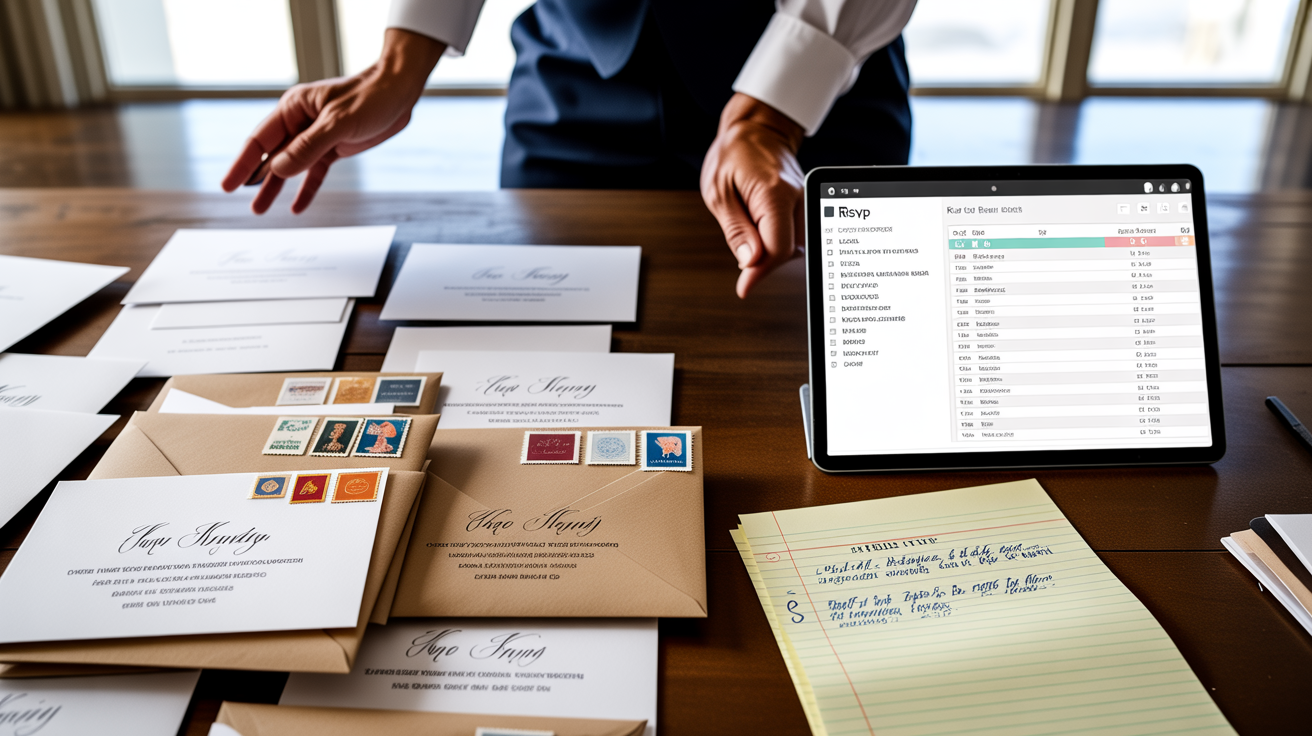
Physical RSVP processing: Someone -- usually the couple, a family member, or a WO coordinator -- manually logs returned cards into a spreadsheet. At 200 guests, this typically takes 6--10 hours across the RSVP window, and that is before following up on the guests who never respond.
Total estimated cost at 200 guests (domestic-heavy list): USD 2,500--4,200, excluding staff time.
The Full Cost of Digital Invitations
Digital pricing is more straightforward, but quality varies enormously.
- Bespoke design fee (studio-produced): USD 300--900 depending on complexity and revisions
- Platform access or hosting: USD 0--150 for the event window
- Distribution: Effectively zero -- sent via WhatsApp, email, or link
- RSVP dashboard and data export: Included in most premium platforms
- Guest communication (reminders, updates): Built into the system, sent in minutes
Total estimated cost at 200 guests: USD 300--1,050. The per-guest cost approaches zero as the list scales.
At 500 guests, paper costs escalate sharply. Digital costs do not move proportionally -- and that is the structural advantage.
Operational Impact: Where Paper Costs You More Than Money
RSVP Response Rate and Speed
Industry data consistently shows that digital invitations achieve 80%+ response rates within 14 days when a clear RSVP link is embedded. Paper RSVP cards, even with return postage included, often trail for 6--8 weeks, with final response rates settling around 55--65%.
The consequence is real: caterers, venue managers, and seating planners all work from guest count data. Every week of uncertainty delays downstream coordination and increases the risk of over-ordering or scrambling.
Last-Minute Change Management
Venue changes happen. Ceremony times shift. A typhoon moves a garden wedding indoors. With a digital invitation, the update takes 10 minutes and every guest receives it instantly. With paper, the options are a reprint (cost and lead time), mass phone calls, or a WhatsApp broadcast that inevitably misses someone.
Dietary and Accessibility Data Collection
Digital invitations can embed structured fields -- dietary restrictions, mobility requirements, meal selections, shuttle preferences -- directly into the RSVP flow. Paper cards require a separate coordination layer: reading handwriting, decoding abbreviations, and manually reconciling data with the caterer's system.
At 300 guests, the difference between a structured digital data export and a handwritten card pile is approximately 4--8 hours of coordination labor.
International Guest Reach
For weddings with guests across multiple time zones, digital invitations arrive simultaneously. There is no postal delay to Mumbai, no customs hold in Lagos, no lost envelope in Toronto. For international weddings -- which are increasingly common across Southeast Asia, the Middle East, and the diaspora communities of Australia and North America -- this is not a convenience, it is a logistics requirement.
Who Should Still Consider Paper
This is not an absolutist argument. Paper invitations remain the right choice in specific contexts:
- Ultra-formal or heritage weddings where the physical invitation is itself a ceremonial object
- Guest lists heavily weighted toward elderly guests who are not comfortable with digital links
- Weddings where the stationery suite is part of a broader printed identity (menus, programs, escort cards) and consistency matters
- Cultures where the physical delivery of an invitation carries relational significance -- a hand-delivered card in many South Asian and East Asian contexts is a gesture, not a logistic
In these cases, paper is not an inefficiency. It is the right medium for the message.
The Decision Framework
Before choosing your format, answer these four questions:
- What percentage of your guests are international? Above 20%, digital has a structural advantage.
- What is your guest list size? Above 150 guests, paper cost compounds aggressively.
- How complex is your event schedule? Multiple venues, days, or ceremony types favor digital's flexibility.
- What is your WO's coordination capacity? If your coordinator is already managing 8+ vendor relationships, adding manual RSVP processing is a real risk.
If you answered 'significant' to any of the first three and 'stretched' to the fourth, you are not choosing between two equally valid options. You are choosing between a system and a process that will require constant manual intervention.
Making Digital Work Without Compromise on Design
The common objection to digital invitations is aesthetic: 'they feel generic' or 'they do not feel special enough for our wedding.' That objection is valid when applied to template-based platforms -- not when applied to bespoke studio design.
A well-crafted digital invitation can carry the same visual weight as a letterpress suite. The difference is in the design execution, not the medium. Wedwebs builds digital invitation systems that are designed to the same standard as premium print -- custom typography, bespoke layouts, branded guest portals, and RSVP dashboards that feed directly into the coordination workflow. If you are ready to see what that looks like at your scale, the portfolio is a good place to start.