Designing for the Village: Digital Invitations and Guest Management for Filipino Catholic Weddings
Filipino Catholic weddings carry one of the most layered guest and sponsor hierarchies of any wedding culture in the world. This guide covers how to design and manage every name, title, and ceremonial role with the precision and respect the tradition demands.

A Wedding Sealed by a Village
In the Philippines, a wedding is not signed off by two people -- it is sealed by a village. The couple stands at the center, but around them stands an entire architecture of family, sponsors, godparents, and community elders whose presence is not ceremonial decoration. It is the whole point. Designing a Filipino wedding invitation means designing for every person in that room, and understanding exactly where they stand within it.
This is one of the most structurally complex wedding cultures in the world to design for. Not because of excess, but because of precision. The hierarchy is real, the titles matter, and getting someone's name wrong -- or listing them out of order -- is a social wound that can outlast the celebration itself.
The Principal Sponsors System: Hierarchy Made Visible
The ninong and ninang system is unlike any equivalent in Western wedding tradition. Principal sponsors are not simply witnesses. They are the formal village elders of this couple's life -- mentors, benefactors, godparents, community anchors -- and a Filipino wedding commonly lists between 10 and 30 sponsor couples, each named individually in the invitation and the program.
Their names are not a footnote. In many Filipino Catholic weddings, the principal sponsor list occupies more typographic real estate on the invitation than almost anything else. The order is hierarchical: the most senior or prominent couples are listed first, and deviation from this order will be noticed. Titles are non-negotiable. 'Dr. and Mrs.' is not interchangeable with 'Mr. and Dr.' When one sponsor holds a political, religious, or professional title, it must appear correctly -- abbreviated properly, in the right sequence.
For a digital invitation studio, this means building a system that can handle 30+ named entries with individual title conventions, render them beautifully across mobile and desktop, and accommodate last-minute changes (sponsors are sometimes added or reshuffled within days of the event) without breaking the design layout.
The Ceremony Structure: Four Symbols, One Covenant
The Filipino Catholic ceremony weaves four physical symbols into the rite that most Western Catholic ceremonies omit entirely. Each has designated holders -- usually secondary sponsors -- whose names also appear in the invitation and program.
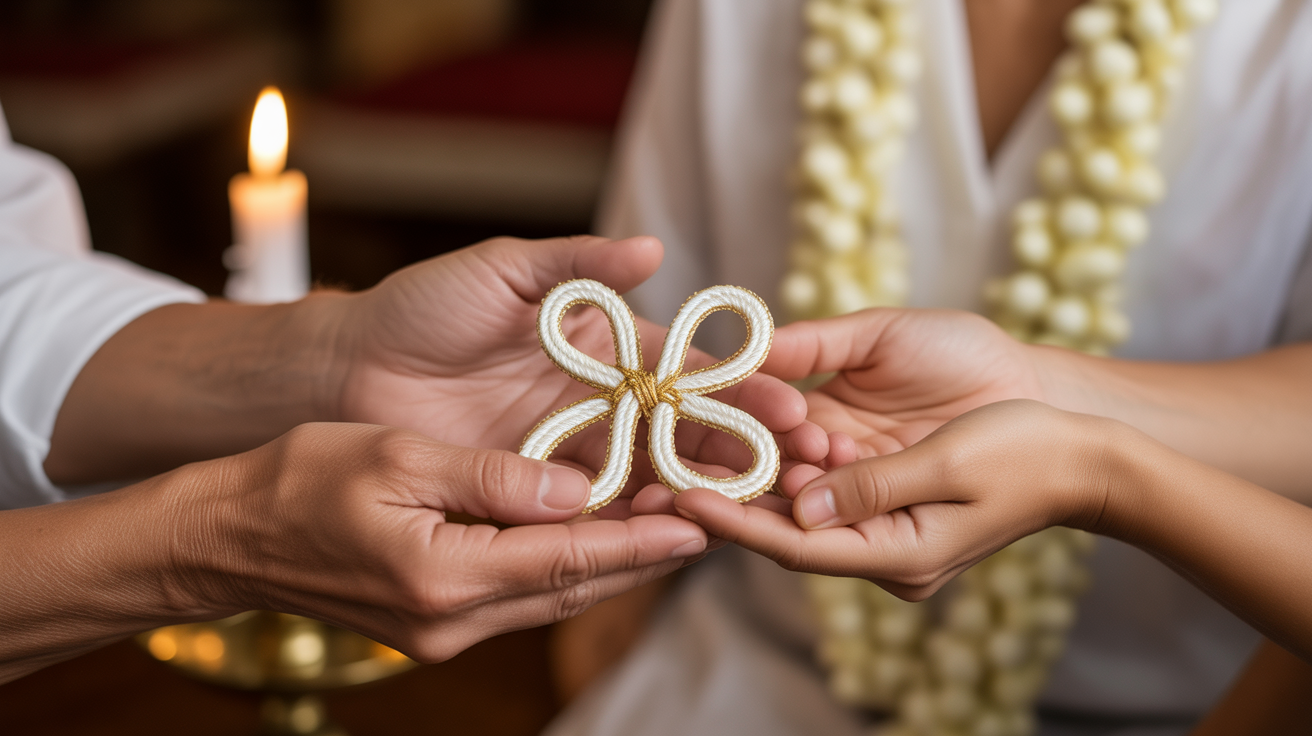
- The yugal (cord): A figure-eight cord looped around the couple's shoulders, symbolizing lifelong unity. It requires two cord sponsors.
- The veil: Pinned over the bride's head and the groom's shoulder by a designated veil sponsor couple, representing the couple being clothed under one roof.
- The arras (coins): Thirteen coins presented by the groom to the bride, symbolizing the entrusting of livelihood. Requires a coin sponsor couple.
- The candle: Lit by a candle sponsor couple, representing the light of Christ entering the union.
Each of these roles must be listed correctly and in proper sequence in both the invitation and the wedding program. A well-designed digital invitation builds this layered dramatis personae into a readable, elegant hierarchy -- not a wall of text, but a structured acknowledgment that feels intentional and dignified.
Designing with Filipino Visual Language
The aesthetic vocabulary of Filipino heritage is extraordinary and deeply underused in mainstream digital invitation design. The most compelling Filipino wedding invitations draw from a specific, non-generic visual vocabulary:
- Piña fabric: Woven from pineapple fibers, piña is the fabric of the Barong Tagalog and the finest Filipino formal wear. Its translucent ivory weave, with delicate geometric repeat patterns, translates beautifully as a texture layer or background motif in digital design.
- Parol geometry: The traditional parol lantern's star geometry -- clean, radiant, symmetrical -- works as both a structural motif and a pattern element, especially for Christmas-season weddings, which are extremely common in the Philippines.
- Provincial embroidery and Inabel weave: From the Ilocos region, Inabel textiles carry stripe and diamond patterns in earthy terracotta, indigo, and gold that can anchor a rich, grounded color palette distinct from the default blush-and-ivory of generic invitation design.
Bilingual presentation is standard, not optional. Filipino and English run in parallel across the formal invitation text, and the typographic system needs to carry both languages with equal visual weight and clarity. This is a design problem many generic platforms simply cannot solve elegantly.
The Guest Management Reality: 400 People and a Culture of Yes
Filipino hospitality operates on a foundational principle: no one should feel unwelcome. In practice, this means guest lists that begin at 300 and frequently reach 400 to 500 across immediate family, extended family, the sponsor network, work colleagues, neighbors, and family friends of family friends. Multiple branches of the family -- often geographically dispersed across provinces, or across continents for the Filipino diaspora in the US, Canada, the UAE, and Australia -- must all be tracked, communicated with, and seated.
The operational challenge is not just scale. It is the cultural resistance to hard cutoffs. When a late guest arrives unannounced, they are seated. When a sponsor brings an unregistered plus-one, they are welcomed. A guest management system for a Filipino wedding needs to be built for graceful overflow, not rigid capacity enforcement.
Digital tools that support real-time RSVP tracking, tiered guest categories (principal sponsors vs. secondary sponsors vs. general guests), and flexible seating management make this manageable in a way that no spreadsheet can. The invitation itself also needs to carry different levels of detail depending on the recipient: principal sponsors may receive a version with full ceremony role information, while general guests receive a cleaner, streamlined flow.
When the System Serves the Sacrament
A Filipino wedding is an act of community documentation. The invitation is not just a logistics tool -- it is the formal record of who this couple belongs to and who belongs to them. Every name listed is an acknowledgment. Every title correct is a sign of respect. Every design choice either honors the weight of that moment or diminishes it.
The studios that serve Filipino couples and WOs well are the ones that understand this before they open a design file. At Wedwebs, we approach Filipino wedding design as a structural and cultural challenge, not a template exercise -- because the village deserves nothing less.
If you are a couple or a Wedding Organizer preparing for a Filipino Catholic celebration, we would welcome the conversation. Explore our portfolio or reach out to discuss a fully custom build.